
The NBTI Framework
A scientific system for observing arousal, cognition, and emotional processing in real time.
What is the Framework?
The framework shifts nonverbal behaviour from intuition to structured observation. NBTI focuses on patterns of behaviour across multiple channels, observed in context and over time. It is grounded in established research on arousal, cognitive load, and emotional processing, treating nonverbal behaviour as dynamic, state-dependent information rather than fixed signals.
This allows practitioners to track observable changes in a client's nervous system moment by moment within the therapeutic setting. From these observations, practitioners can form hypotheses about how a client's thinking and emotional processing are changing, and then test and refine these through reflective, investigative questioning. This supports clearer professional judgement and better-timed interventions in live practice.
The Core Model: Nonverbal ACEs
Three fundamental processes that drive observable behaviour.
Arousal
The moment-to-moment activation state of the autonomic nervous system, reflected in patterns of regulation, mobilisation, or shutdown.
Cognition
The level of mental effort and processing load visible in behaviour, indicating how information is being managed, integrated, or inhibited in real time.
Emotional Processing
The degree to which emotional experience is being actively processed, regulated, or bypassed, as reflected in embodied and expressive behaviour.
Why Nonverbal Behaviour Analysis?
The body keeps the score, and it broadcasts the score in real-time.
Pre-Verbal Processing
The nervous system responds before conscious language is formed, revealing shifts in arousal and processing as they happen.
Reduced Narrative Control
Nonverbal behaviour is less shaped by social desirability and cognitive editing than speech.
Real-Time Calibration
Observable moment to moment, allowing practitioners to adjust pace, focus, and intervention immediately.
The 10 Channels of Observation
NBTI provides a systematic way to scan and track changes across ten distinct channels. We teach you exactly what to look for in each.
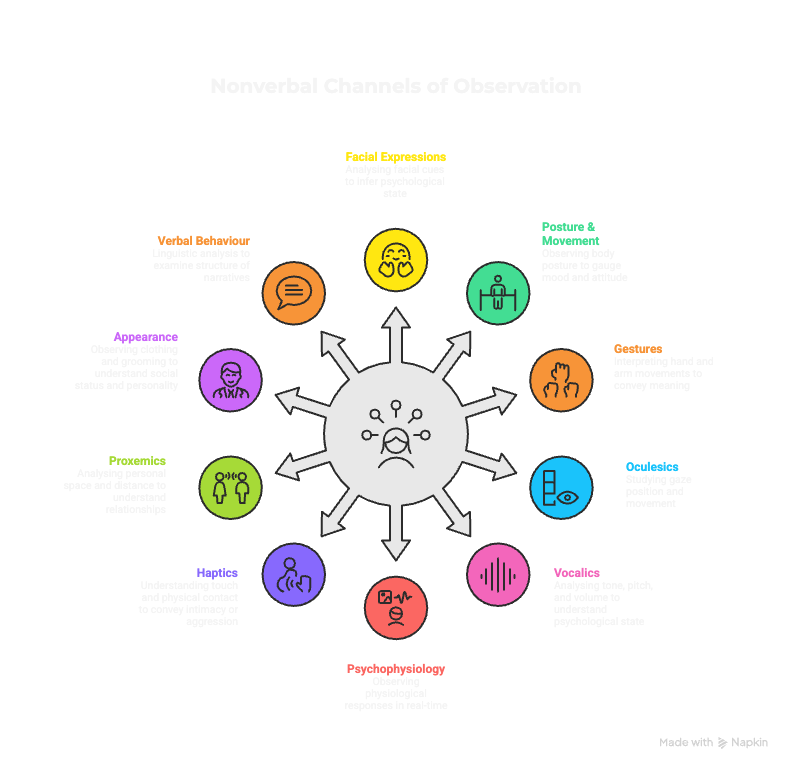
Integrated Behavioural Observation
Contextual Interpretation
Behaviour is understood in relation to what surrounds it — including timing, sequence, and situational context.
Cross-Channel Patterns
Insight emerges from clusters of signals observed across multiple behavioural channels at the same time.
Triangulated Judgement
When observations converge, hypotheses gain strength, supporting clearer and better-timed professional decisions.
The Applied Process: ONCE
A simple, repeatable operational flow for any session.
Observe
Scan the 10 channels for baseline behaviour.
Notice
Identify deviations and clusters (ACEs).
Connect
Triangulate signals to form a hypothesis.
Enquire
Use the data to guide therapeutic enquiry.
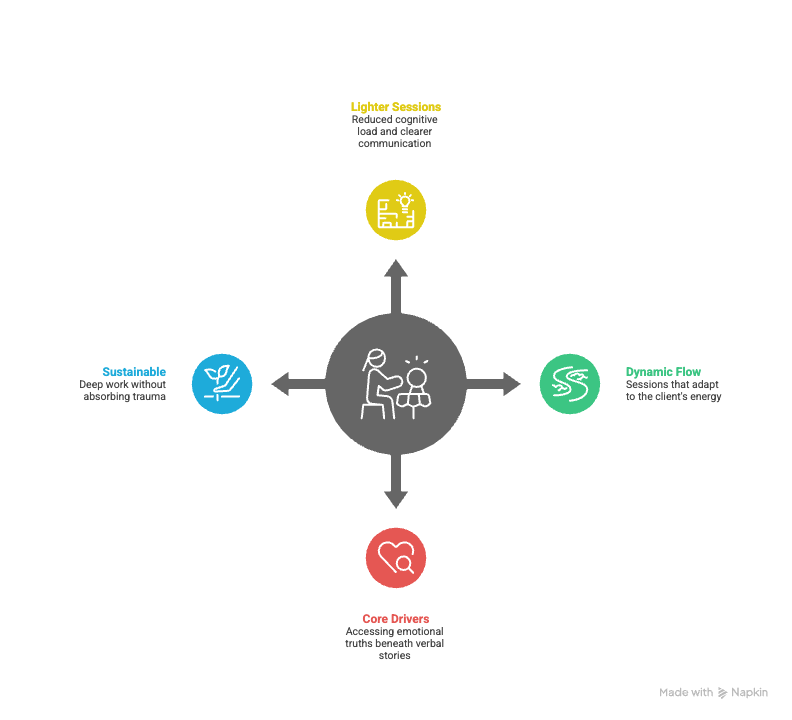
Therapeutic Impact
When you can see the mechanics of the nervous system in motion, therapy becomes less of a guessing game and more of a guided navigation.
Lighter Sessions
Less cognitive load wondering 'what did they mean?'.
Dynamic Flow
Move with the client's energy, not against it.
Core Drivers
Access the emotional truth beneath the verbal story.
Sustainable
Work deeply without absorbing the trauma.
Seamless Integration
NBTI is not a new therapeutic modality. It is an observational layer that sits underneath whatever model you currently use—CBT, EMDR, Psychodynamic, or Somatic.
It supports supervision and reflective practice by providing objective data to review.
Ready to decode human behaviour?
Join the next generation of therapists and master the science of nonverbal behaviour analysis.